
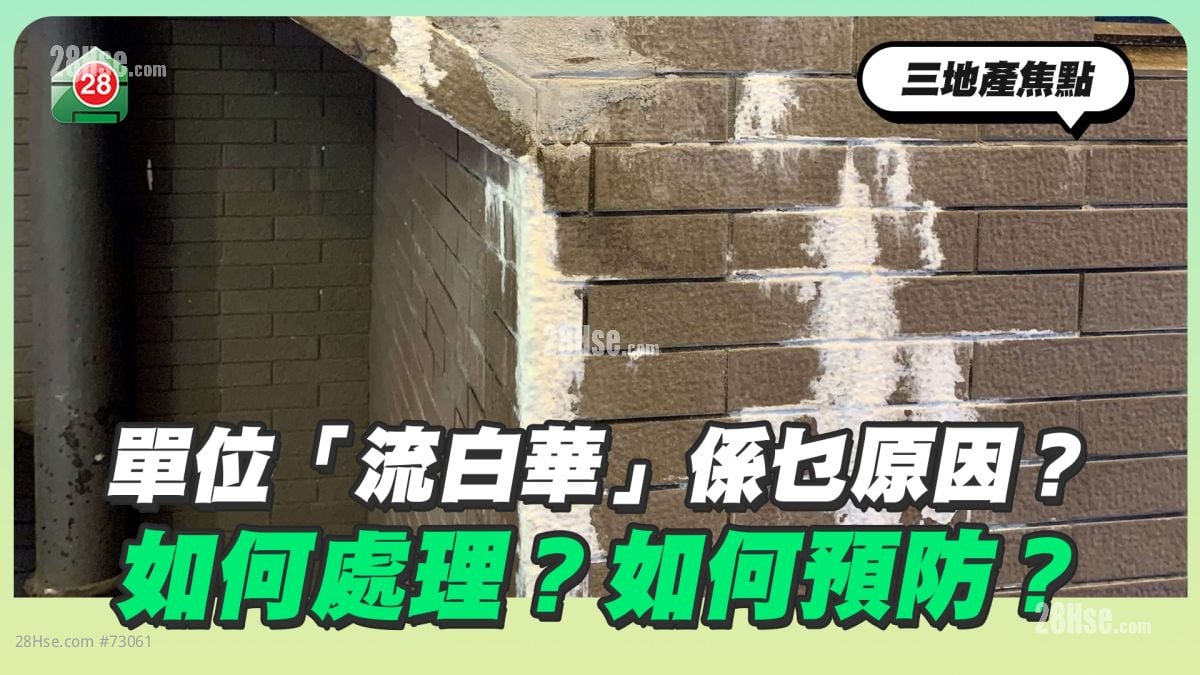
Recently, Home Ownership Scheme (HOS) flats built using "Modular Integrated Construction" (MiC) technology have raised quality concerns due to past water leakage issues. i-Cable News invited a building inspection expert to inspect the kitchen and bathroom of Kwun Tong’s On Ying Court, which was constructed using prefabricated components.
The inspector discovered patches of white to greyish-white substances emerging from the kitchen floor tiles, identifying it as "efflorescence." This suggests the possibility of cracks in the walls or flooring, and the Housing Department should be notified to locate and address the source of the cracks.
The inspector noted that efflorescence is typically seen in much older properties, making its appearance on indoor flooring particularly rare. Additionally, visible water stains were found near the ceiling of the bathroom walls, with clear signs of rust-coloured stains. The inspector also recommended that the homeowner contact the property management office for repairs. The final inspection score for the unit was 63 out of 100.
Efflorescence, a term that may be unfamiliar to many, refers to the crystallisation of white salt deposits caused by water interacting with soluble salts in construction materials like concrete or bricks. These salts are drawn to the surface as water evaporates, often occurring where water seepage is present. This phenomenon is difficult to prevent and can signal deeper issues.
Efflorescence can be dealt with in two main ways: surface cleaning and addressing the root cause. To clean the surface, products like efflorescence removers are available on the market to break down crystallised deposits. For thicker deposits, tools like scrapers may be required.
However, if the underlying issue isn’t resolved, efflorescence will likely reappear. The first step is to identify and fix any water leakage, eliminating the source of moisture. In some cases, due to complex underlying factors, it may not be possible to completely eradicate the problem.
If the leak source cannot be located, residents can also reduce moisture by adjusting daily habits. For example, keep concrete or brick surfaces as dry as possible, avoid using overly wet mops for cleaning, and dry bathroom surfaces after use to minimise humidity.
Homeowners may also consider using efflorescence inhibitors, which chemically react with calcium compounds in cement to reduce the risk of efflorescence. However, these inhibitors have a drawback: they can reduce the strength of cement. Cement treated with efflorescence inhibitors is typically only about 60% as strong as untreated cement.
Efflorescence inhibitors can be applied as a preventive measure during construction or as a post-construction treatment. It’s important to note that these inhibitors are mainly suitable for materials like stone, tiles, concrete, and cement walls, but not for materials containing gypsum, lime, or painted surfaces.