Our Hong Kong Foundation (OHKF) recently published its Hong Kong Housing Landscape Navigator 2026 report, highlighting that it is time for Hong Kong to systematically promote public housing redevelopment. The report points out that 41,000 public housing units are currently planned or under redevelopment, far exceeding the cumulative completion of around 17,000 units over the past decade.
The report identifies the aging of public housing estates as a significant challenge for housing policy. Many early-built estates are now entering an advanced age, with building aging problems becoming increasingly apparent. Over the next decade, it is projected that more than 230,000 public housing units under the Housing Authority will reach 50 years of age.
To address these issues, the Foundation has proposed three key recommendations: (1) allocate 10% to 15% of the annual public housing completion volume as a dedicated relocation reserve to assist residents displaced by redevelopment; (2) include a “redevelopment quota” as a separate category in the housing supply targets under the Long Term Housing Strategy; and (3) increase the proportion of subsidised sale flats in appropriate redevelopment projects. This cross-subsidy model could reduce net expenditure by up to 78%.
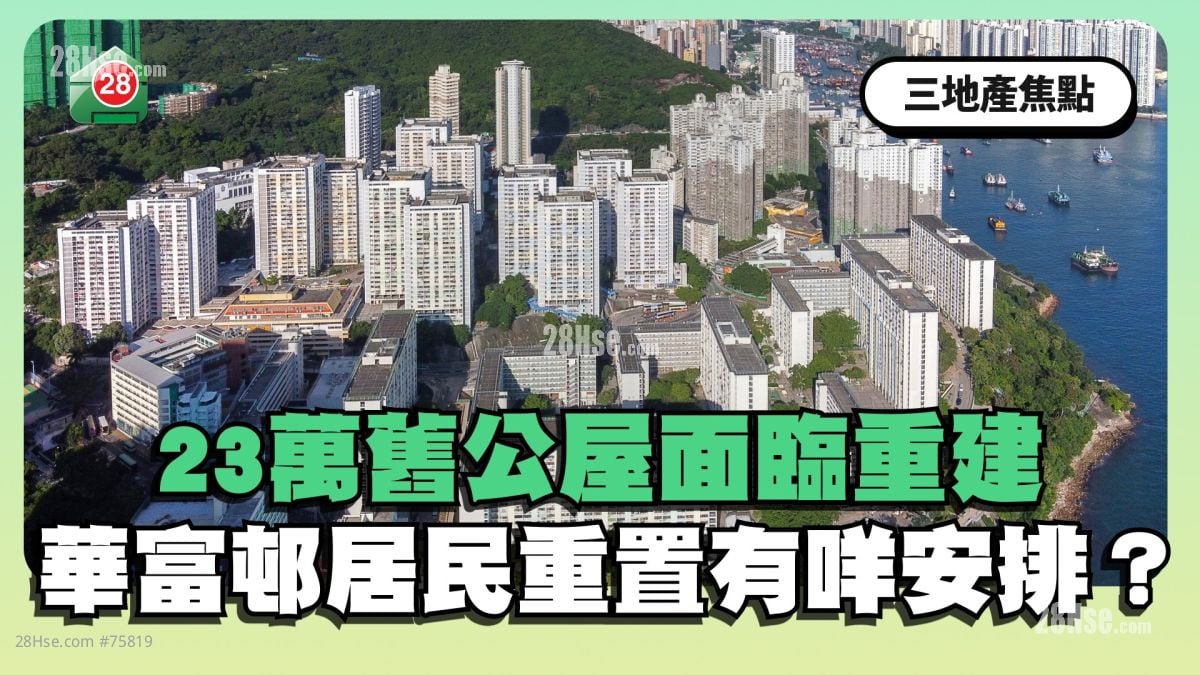
The redevelopment of Wah Fu Estate includes relocating affected residents to new homes. The Hong Kong Housing Authority has outlined the demolition and relocation plans for Phase 1b, which will involve Wah Cheong House, Wah Tai House, and Wah Kin House. Residents will be given a 59-month notice period, with the goal of fully vacating the buildings by March 2031.
For the residents affected, nearby public housing developments, Wah Lok Path and Wah Fu North, will provide new homes. These projects are set to open in 2028 and 2030, offering 2,243 flats—enough to house the 1,980 households moving out of Wah Cheong, Wah Tai, and Wah Kin Houses.
Residents can also choose to move to leftover units on Wah King Street (built during Phase 1a) or to vacated public housing flats in other districts, if available. Final relocation arrangements will depend on available resources and the specific needs of each household.
Some residents affected by the Phase 1b demolition may move out earlier than expected, which could leave some units vacant for an extended period before demolition. To make use of these empty flats, the Housing Authority plans to renovate those in better condition and rent them out temporarily to people waiting for public housing. These short-term leases will start at least 24 months before the demolition date.
Residents moving out will receive a relocation allowance to help cover moving costs. The allowance, based on household size, ranges from HK$10,350 to HK$33,050. Single-person or two-person households that decide not to move into a new public housing unit can apply for a cash allowance instead, with payments of up to HK$79,440 and HK$98,400, respectively.
For those interested in buying their own home, there’s an option to give up their public housing allocation in exchange for priority access to subsidised housing sales. This includes flats from the 2025 Sale of Home Ownership Scheme and the Sale of Green Form Subsidised Home Ownership Scheme Flats 2025.