
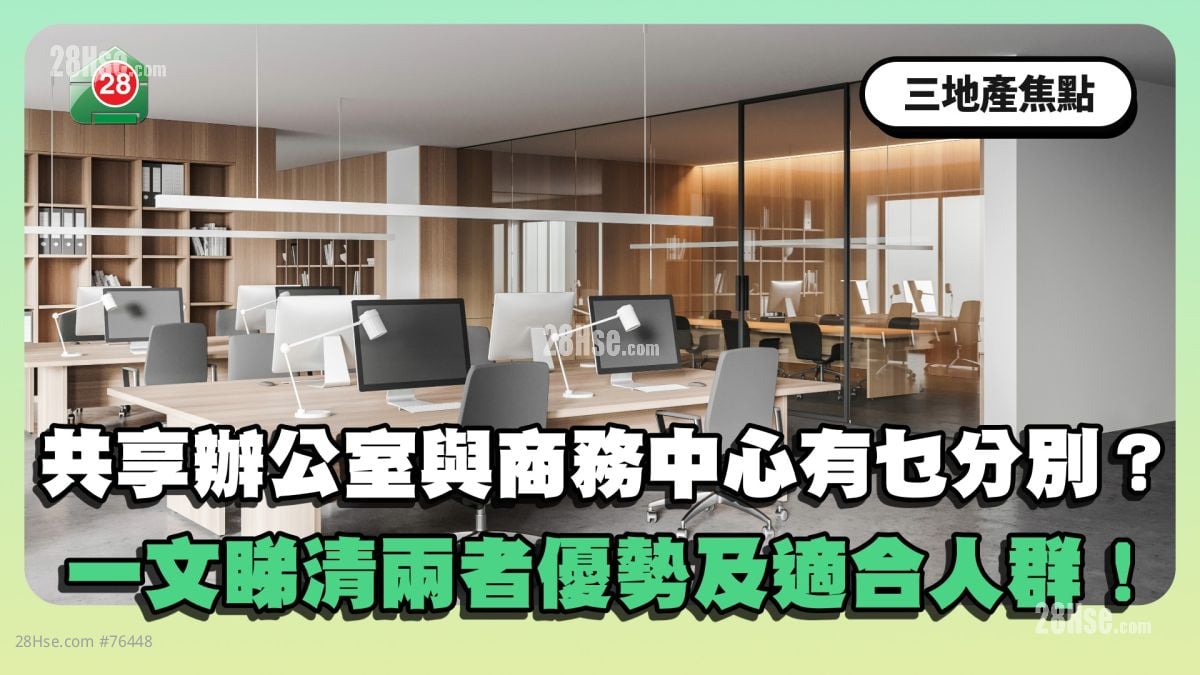
As times change, office models have also become increasingly diverse, and businesses may not necessarily need to rent an entire office. Many people choose coworking spaces or business centres, which some also refer to as serviced offices. The two appear similar, both providing flexible office solutions, but what exactly are the differences?
A coworking space refers to a well-equipped office space that allows workers from different industries and different companies to work in the same location. Such spaces usually adopt an open-plan design and provide flexible seating arrangements and shared facilities, such as meeting rooms, printing equipment and internet services, making them suitable for freelancers, startups and people who need flexible office arrangements.
The benefit of renting a shared office is its higher flexibility. Tenants do not need to lease an entire office and can also choose different plans according to their needs. Rental periods can be as short as by the hour, with single-day and monthly rental options also available, eliminating the pain of being tied down by a long lease and helping to reduce rental and operating costs.
In addition, since the workspace mostly adopts an open-plan design, users also have the opportunity to meet people from different industries, expand their networks, and even inspire opportunities for collaboration, resource sharing and business exchange, achieving mutual benefit.
However, coworking spaces also have their drawbacks. Since most of the space is a shared environment, the level of privacy is relatively lower, and daily work may also be affected by other users’ conversations, meetings or activities. For companies that require a high level of confidentiality, frequently handle sensitive documents, or need a quiet working environment, a shared office may not be the most ideal choice.
As for business centres, they are generally located inside Grade A or Grade B commercial buildings. Usually, an operator first leases an entire floor or part of a floor, then partitions it into multiple independent small offices for sublease to different tenants. Their tenants are mostly startups, foreign companies testing the waters, or companies with short-term needs.
The benefit of a business centre is that it can provide lockable independent office rooms, with a higher level of privacy than shared offices. The overall image also appears more professional, making it more suitable for companies that need to handle confidential documents, receive clients or hold internal meetings.
In addition, some business centres also provide supporting facilities such as a reception area, telephone answering, mail collection, meeting rooms, printing equipment and a pantry. Tenants can rent and use them immediately, without having to renovate or purchase office equipment themselves, which is more convenient for companies that wish to save startup costs and time.
However, business centres also have certain drawbacks. Since renovation, management and various office facilities are already included, the rent is generally higher than that of ordinary subleased offices. Moreover, the office area is usually smaller, and the layout and renovation style are also arranged by the operator, leaving tenants with limited room to make changes themselves.
If a company’s headcount increases or it needs to expand in the long term, a business centre may not be able to provide sufficient flexibility. At that point, it may need to look again for a more suitable office space. In addition, some shared facilities, such as meeting rooms, still need to be reserved for use, and arrangements may not be available immediately during peak hours.